Tuesday, 24 November 2015

Alignment and Preparation for the Build

Having got all the stations fitted, I now take the moulds down, one by one. Firstly, I have to cut them in half and then hold the two halves together by butt-straps.

Three butt straps holding the two halves of the mould together
  
The reason I have to do this is that I will not be able to remove the moulds from the finished boat as they will be too tight a fit. So what I have to do, when the boat is finished, is remove the butt-straps and then the moulds can be taken out of the hull in two halves.

Whilst the mould is out, I cut out a notch 1" x  3" (25 x 75mm) to accept the hog: which is a long piece of timber (1" x  3") that lies on top of the keel.

The notch for the hog

I now return and secure the mould back on its station, making sure it is exactly vertical and aligned along the centre line. To do this I tie and stretch a piece of string along the centre of the notches I have cut for the hog (remember the boat is built upside down, with the keel on top.)

String tied along the centre line of the boat

Having got the station accurately back in place I give extra security to it by adding stays that secure the uprights to the strongback
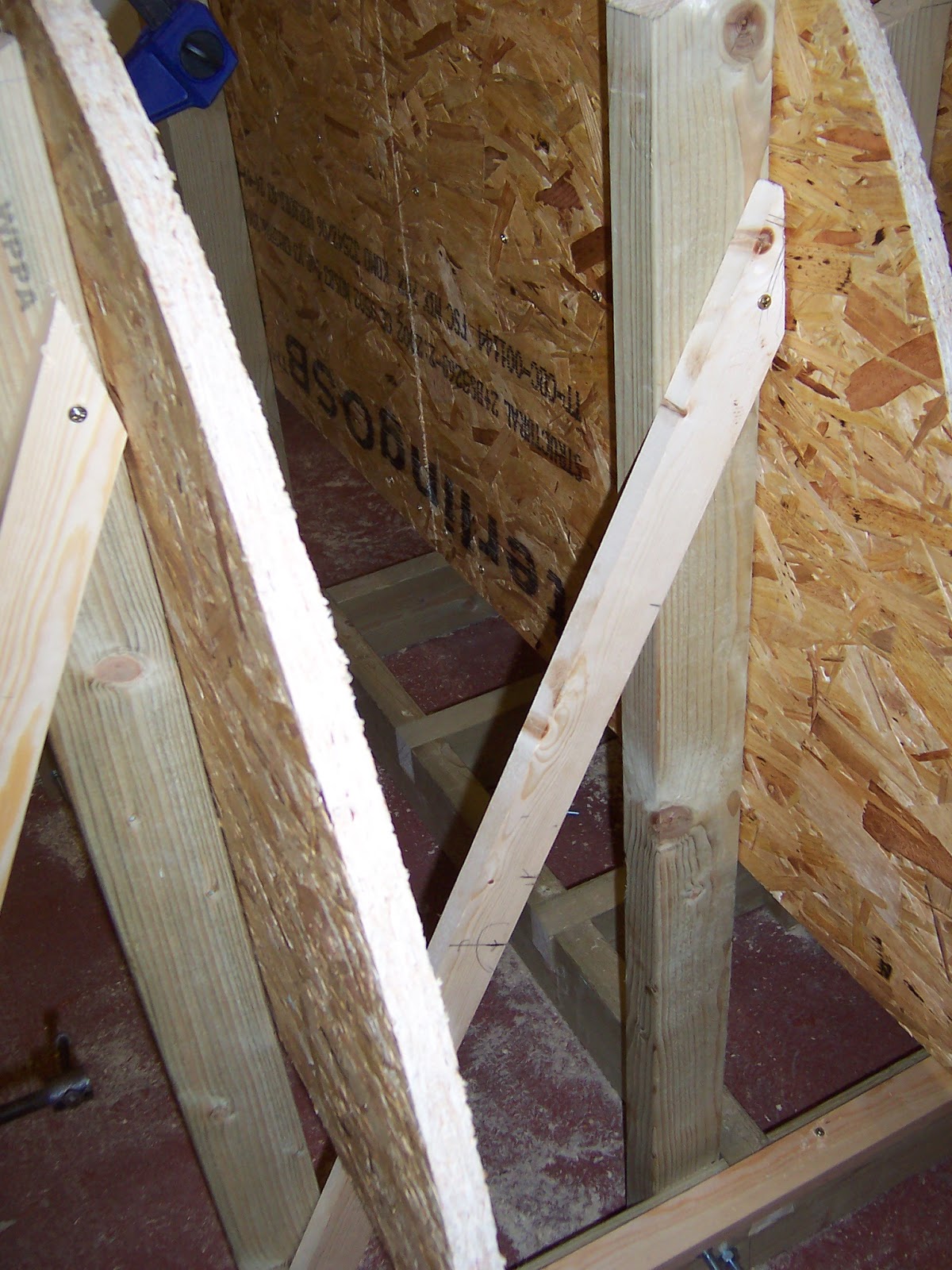
Stays holding the station in the correct posotion

As you might have noticed, constructing the building jig is very time consuming, but, just like a painting is only as good as the drawing beneath it, so a boat is only as good as the building jig upon which it is built. 

I have to resist adding, in every post: 'fingers-crossed', 'hopefully', 'with any luck'.  


Wednesday, 18 November 2015

Transom in Place ... Timber Ordered

The Transom, the very first piece of Seagull, has been fixed to the Building Jig.


The length of the vessel starts to become obvious, although it is difficult to get a photograph of the whole thing: below the transom can only just be seen at the far end.


Space in which to work continues to be the main problem, particularly when the bulk of material arrive. I am looking at ways to use the masses of room above my head. 

I ordered and paid for the bulk of timber today, which allows me to print the current costed Bill of Materials below. 

BILL  OF  MATERIALS


Cost to Date:

Note. UK cost includes 20% tax. This 20% is carried across into the US$ cost as well.

                                                                                                         £                 (US$)

Plans                                                                                               75.0             (114)
Timber for Building Jig                                                                 355.15            (542)
60 Bolts nuts and Washers                                                            42.50              (66)
(60 of Zinc Plated Coach / Carriage Bolts
with Nuts M10 10mm x 150mm)
1 sheet 8' x 4' x 3/4" Marine Ply                                                      50                 (76)
6 sheet 8' x 4' x 1/2"    "         "                                                       244               (372)   
All Douglas Fir, Utile and Cedar                                                  2696              (4105)

Tuesday, 17 November 2015

The Twelfth Station Now In Situ.


I don't know if there is superstition in such things, but the thirteenth station will be the transom ... which is shown as station 0 (ZERO). I only add time to get this station in place today, but I'm hoping for a full day tomorrow.

I've had the quote back from Robbins Timber in Bristol, for most of the timber needed for the build, and it total's out at £2696 (US$ 4105). I'll check it out tonight and order tomorrow. They say the lead time is 10 working days, so expect it the first week in December: I always add a few days.


Monday, 16 November 2015

TEAK!

A good friend of mine Julie Ford Oliver (see her blog here Link ) 
left a comment to my last posting that included the following:


"At one time I thought teak was best for boats, but remembered a friend using it and the glue didn't stick or something like that"


Julie knew nothing about my 'thing' with teak.

Here's the story:

As a shipwright apprentice, in my third year, I worked on a floating dock for a while. You can see a tiny bit of it in the top right hand corner.


To get to it we walked past the white building along a gangway, out over two pontoons, and across a brow (gangplank) onto the dock. All this was called the 'Cornwallis Jetty'.


In 1964 the dockyard was sold by the Admiralty (Navy Dept) to a private company, who were to convert the place to a Container Port. The private company ripped out everything you can see on the photograph, and below all that planking was ...HMS Cornwallis


Whereas all British Warships were made of Oak, or so we generally believe, the Cornwallis was made completely of Teak, the finest boat building timber possible: it is almost impervious to seawater constantly generating oil - this oil makes it difficult to glue, but glue wasn't used on such ships.

The Cornwallis was unusual as she wasn't built in Britain but in Bombay, India.

Bombay was famous for its Parsi families whom were descended from Persian Zoroastrians who had emigrated to India to avoid religious persecution from both Muslims and Christians. These families provided great Wadias (shipwrights), and it was to these that the Royal Navy turned. One in particular was the Master Shipwright that built the Teak, 54 gunner Cornwallis, and his name was Jemsatjee Bomanjee.


 He also built at the same time (1815) HMS Trincamalee which is still afloat in the UK at Hartlepool. Here are a few images of the Teak ship.


Incidentally, the Cornwallis fired the last shot in the American War of Independence. The Treaty of Nanking was also signed on her quarterdeck.

Finally, the private company that bought the dockyard ... burnt the Cornwallis!!!!

Saturday, 14 November 2015

Dressmaking and Arguably The Most Important Piece of Wood ....so far ...

The very first piece of wood that will be part of the boat has just been rough cut out of a sheet of Marine Plywood, and here it is.


'Seagull's' Transom 
To those that understand such terms, this is Seagull's transom, that is to say the piece of wood at the back end of the boat.


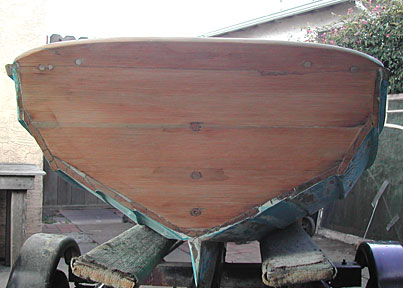
Here is an example in real life that I found on the Internet


I realise that this is all a bit confusing to my buddies who aren't really familiar with boat building. "If this is the first bit of wood, what's all the other stuff you've been building?" I hear them ask. So the next bit is for them.

OK think of dressmaking ... think of the boat as an elaborate dress. You cut out the pieces of dress using patterns you buy, which is the same as me cutting out the transom from the plans I bought.    Now you might have to have a dressmaker's dummy specially designed for the exact shape of the person you are making the dress for:


Let's not call it a dressmaker's dummy ... let's call it a 'building jig'


So this is my dressmaker's dummy (building jig).

Does that make sense? without meaning to be patronising. 

Friday, 13 November 2015

Storms Rage and the Marine Plywood Arrives

The Jet Stream has dipped and is sending storm after storm across the Atlantic to pound against the cliffs outside. A good time to be building boats rather than sailing them.

I've made all the moulds (molds) now but I couldn't mount them on the building jig as I needed the floor space to cut up the large sheets. Below is a sheet laid horizontally ready for marking.


. 


I select the appropriate section from the plan of moulds


and mark it out on the sterling board.


 I use nails to mark out full size the shape to be cut 


then run a batten around the nails, and pencil around the batten.


 Finally, I remove the batten and nails and cut around the pencil line with a jig-saw.


The marine plywood arrived from my local supplier today, the thickest sheet, 8' x 4' x 3/4  (2500 x 1250 x 18), cost £42 (US$ 64), it was going to cost £126 a sheet from the place in Bristol, great saving there.

Altogether the plywood sheets cost £294 including 20% tax.

Therefore the cost to date is

Cost to Date:

Note. UK cost includes 20% tax. This 20% is carried across into the US$ cost as well.

                                                                                                         £                 (US$)

Plans                                                                                               75.0             (114)
Timber for Building Jig                                                                 355.15            (542)
60 Bolts nuts and Washers                                                            42.50              (66)
(60 of Zinc Plated Coach / Carriage Bolts
with Nuts M10 10mm x 150mm)
1 sheet 8' x 4' x 3/4" Marine Ply                                                      50                 (76)
6 sheet 8' x 4' x 1/2"    "         "                                                       244               (372)   

Tuesday, 10 November 2015

The Front Stations in Place

Well the front half is done - station wise. I'll start on the other half tomorrow although I have a lot going on away from the boat.

The Front Seven stations, of the total Thirteen, in place